Launched a second blog just for photographs.
See 'Lrong Lim Photos' at http://lronglimphotos.blogspot.com/
Will retain the current blog for the occasional rant.

Gardening, Shakuhachi, photography, cooking, fishing, traveling, skin diving, life in Japan, plus of course, news and views of being away from home...
Wednesday, May 04, 2005


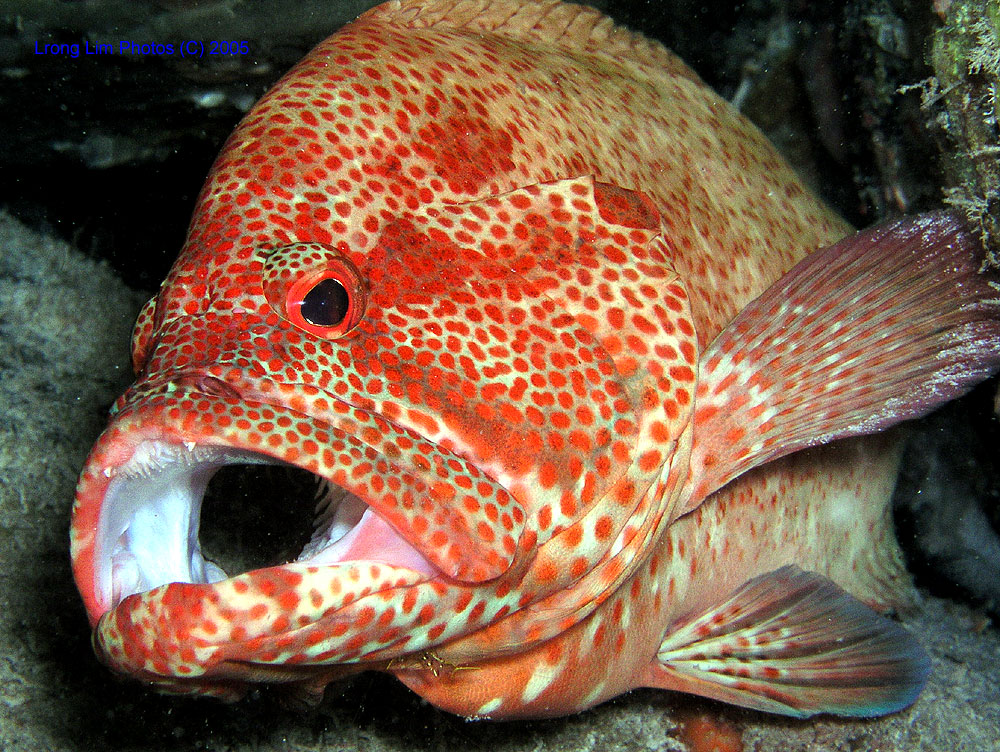
Coral trout at cleaning station
Decided to start a second blog dedicated to photography.
I have been shooting pictures for about 20 years. Started off with Canon A1. Moved on to Nikon FM2, and then to the F and F2AS.
These film cameras are hibernating these days while the digitals (Nikon and Olympus) get into action.
Favorite subjects are portraits but I also enjoy shooting sunsets, night scenes, flowers, and underwater as well.
I earned my scuba license in early 2001 in Koh Tao, Thailand, and have been shooting underwater for over two years now.
It is a pleasure to share my pictures with anyone who drops by the blog.
The picture above was taken in a ‘sunrise’ dive.
While my buddies were snoring, I crawled out of the bed at 5.00 am and hit the water at 6.00 am.
In the early morning, the marine creatures are sluggish, just like humans.
This coral trout is being serviced by a cleaning shrimp; you can see the legs of the shrimp at the lower part of the fish’s mouth.
Photo distance to the subject was about one meter.
The trout appeared to enjoying the cleaning so much so that it did not bother to move away when I zeroed in.
Note: Previous posts of photos can be viewed at 'Kedahan-Malaysian in Japan ' http://lronglim.blogspot.com/
Tuesday, May 03, 2005
Sundown at Morib

Was strolling by Morib beach when I noticed this young lady gazing at the sunset.
What could be on her mind, I wondered...
Monday, May 02, 2005
Fishtail palm tree flowers
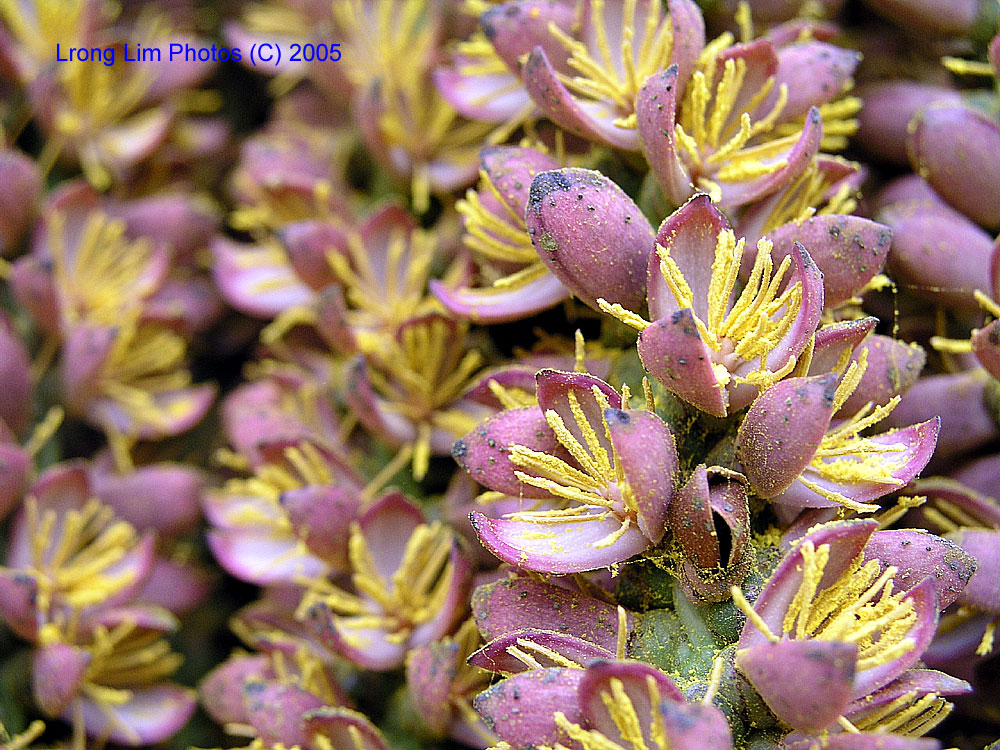
Ornaments from the palm
This is a picture of flowers from the fishtail palm tree that I took at a friend's garden.
The fishtail palm tree got its name from the shape of the leaves that resemble the tails of ornamental fish, particularly that of the comet goldfish.
I was quite surprised to see that its way of flowering is opposite to the 'normal' way, that is, the first clusters of flowers emerge from the top of a mature tree, followed by subsequent clusters down the trunk.
Since my friend is seldom in the house, birds like the Philippine Glossy Starling (a small black bird, somewhat like a mini crow with red eyes) come by to nest in the cleavages.
The crimson-like fruits attract the Black-napped Oriole, a beautiful yellow bird with a loud fluty call. (The oriole is my favorite bird, too.)
The fishtail palm tree apparently dies when the flower cluster reaches the ground.
It reproduces from the baby suckers growing out from the mother plant at the base, like the banana plant.
Sunday, May 01, 2005
Redang... the Clown fish
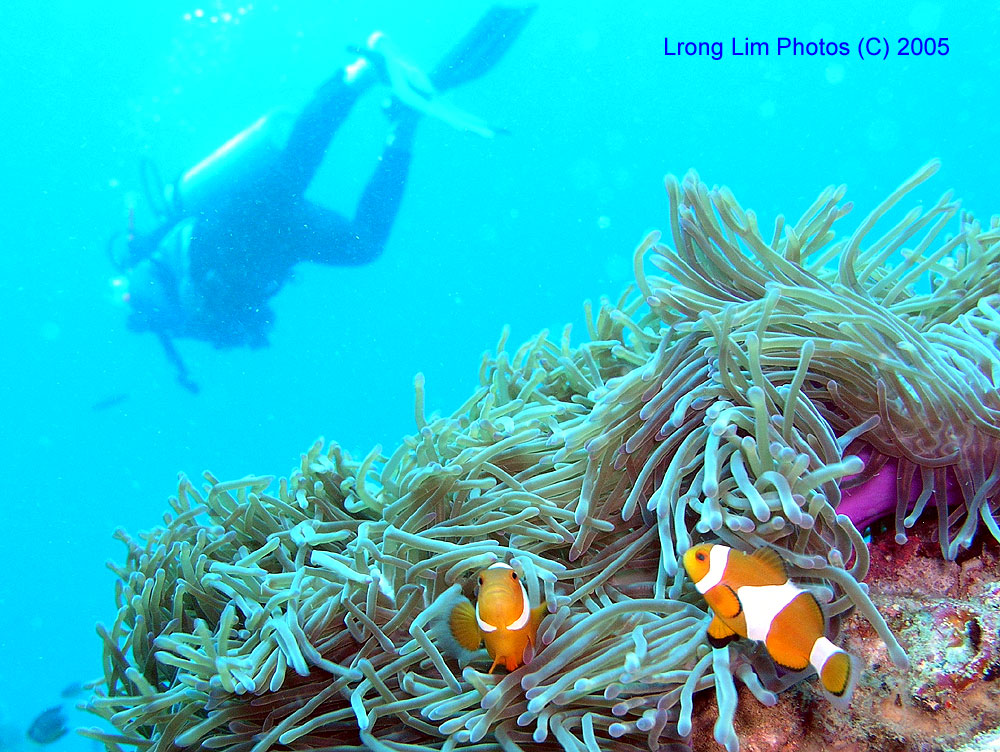
Buddy descending near the House of the Clowns
Been taking underwater pictures for over two years now. Although my preferred brand is Nikon, which I use for pictures above water, the equipment that gets to travel with me in the underwater world is the Olympus C5050. It is by any measure, a very good camera.
The picture above shows a couple of anemone fish, or clown fish. False clown fish, to be more precise. The 'true' clown has a clear, rather black line encompassing the whites. I wonder why the distinction through the concepts, 'true' and 'false'.
I do not have an external flash unit. Several reasons why. Too bulky to carry. Too technical for me. And most important, that diver in the picture is my dive buddy, and also my Minister of Finance. And I have yet to CONvince her on why I really, really need this flash unit.
So, you can see the sometimes-distracting backscatter; those circular reflections of the internal flash unit by the water particles. What to do but to accept this compromise?
Clown fishes start off life as sexless creatures. Their host is the anemone, that tube-like stuff in the picture. This particular type of anemone is called the purple magnificent anemone. Normally there are several clown fishes inhabiting one anemone.
The anemone stings if you touch it. It is presumably poisonous but the clowns have adapted to the poison and the poisonous anemone helps to protect the clown from predators.
When a novice diver, I have tried to touch (I am sorry, I promise I won't do it again!) the anemone and it felt rather 'scrappy', quite a bit like touching fine sandpaper. Lucky I wasn't stung by it.
The female is supreme in the world of clown fishes, with the male literally being her right hand man. If and when the female dies, the male changes his sex into female and takes the lead. The largest among the sexless juveniles will become the male.
Subscribe to:
Posts (Atom)